
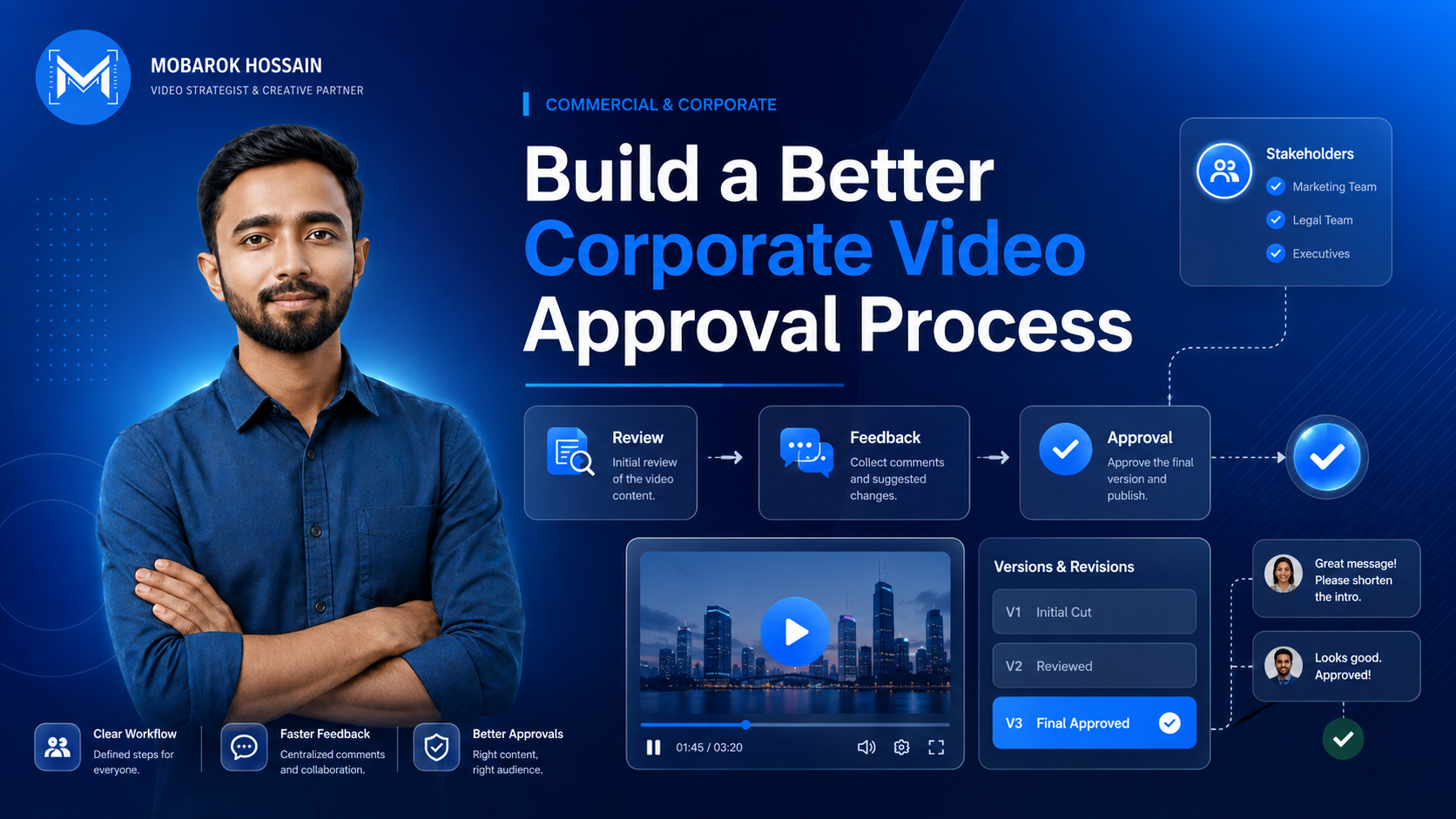
corporate video approval process is best understood through the job the finished video must perform. Business video should have a defined audience, communication job and approval path. Brand polish matters, but rights, factual accuracy, accessibility and delivery versions determine whether the asset can actually be used.
A useful price discussion starts with the work and risk inside the scope. A rate without source-volume, creative responsibility, version and review assumptions cannot be compared fairly. This guide focuses on decision ownership, consolidated feedback, factual review, change control and final sign-off. It uses clearly labelled hypothetical examples and does not claim that editing alone guarantees reach, retention, leads or revenue.
Clarify the audience and intended outcome
Start with one audience, one viewing context and one next action. Explain what the viewer already knows, what uncertainty the video should remove and which factual or brand rules cannot change. This creates a decision standard for “Build a Better Corporate Video Approval Process” instead of allowing personal style preferences to control the project.
The brief should identify the source of truth for claims, names, product details and mandatory disclosures. If the content will be reused, list the channels and lifecycle stages now. A homepage visitor, YouTube subscriber, paid-social viewer, sales prospect and employee do not need the same amount of context.
Business objective
Translate this stage into a written decision. For corporate video approval process, the team should confirm who owns the input, what evidence is required and what an approved result looks like. The strongest creative choice is the one that supports comprehension and the intended action without making unsupported promises.
Use a business objective, audience, approved messages, representative footage, brand and legal requirements, distribution plan and named approvers. Representative material exposes technical and editorial uncertainty before a quote or schedule becomes a commitment. Missing information should be recorded as an assumption rather than silently guessed.
Brief and approvals
Separate structural decisions from finishing decisions. First approve message, sequence and necessary evidence. Then review graphics, captions, sound, color and brand treatment. Late changes to the objective or story are scope changes even when they arrive inside an ordinary comments round.
Evaluate a focused message, credible evidence, brand consistency, understandable audio, accessible delivery, complete rights and placement-ready versions. The final duration alone does not describe the effort: source volume, research, visual complexity, audio condition, versions, urgency and the number of approvers can change the work substantially.
Story and brand treatment
Create a delivery matrix with final duration, aspect ratio, caption treatment, language, file type and destination. Confirm source-file, stock, music, font and template rights. If customer, employee or unreleased product material appears, document appropriate permission and access controls.
Choose a measurement signal that fits the video’s job and placement. Use performance as learning rather than proof of single-cause attribution. Topic, offer, audience, distribution and timing also influence the outcome.
Accessibility and versions
Translate this stage into a written decision. For corporate video approval process, the team should confirm who owns the input, what evidence is required and what an approved result looks like. The strongest creative choice is the one that supports comprehension and the intended action without making unsupported promises.
Use a business objective, audience, approved messages, representative footage, brand and legal requirements, distribution plan and named approvers. Representative material exposes technical and editorial uncertainty before a quote or schedule becomes a commitment. Missing information should be recorded as an assumption rather than silently guessed.
Delivery and measurement
Separate structural decisions from finishing decisions. First approve message, sequence and necessary evidence. Then review graphics, captions, sound, color and brand treatment. Late changes to the objective or story are scope changes even when they arrive inside an ordinary comments round.
Evaluate a focused message, credible evidence, brand consistency, understandable audio, accessible delivery, complete rights and placement-ready versions. The final duration alone does not describe the effort: source volume, research, visual complexity, audio condition, versions, urgency and the number of approvers can change the work substantially.
A practical production and review sequence
- Approve the audience, objective, placement and source of truth.
- Audit representative files, dependencies, rights and technical risks.
- Confirm deliverables, exclusions, milestones, dates and the authorized approver.
- Approve structure before detailed animation, graphics or final sound.
- Complete factual, accessibility, rights and export quality control.
- Archive masters, licenses, approved copy and maintenance notes.
A clearly labelled hypothetical example
Hypothetical example: a team requests “Build a Better Corporate Video Approval Process” but initially shares only a deadline. A workable brief adds the intended audience, representative source material, one reference with notes, required versions, mandatory claims, one structure review and one finishing review. The provider can now identify missing assets and quote a visible scope.
This is not a client case study and does not predict performance. It illustrates how a vague search term becomes a responsible production decision. A real project may need fewer or more controls depending on confidentiality, legal exposure, creative complexity and distribution.
Common risks and red flags
- Comparing prices built on different deliverables.
- A fixed promise before representative assets are reviewed.
- Unlimited revisions without a feedback or change process.
- Third-party rights and source-file dependencies omitted from the quote.
Accessibility, rights and maintenance
Use accurate captions, readable contrast, safe text placement and understandable audio. Verify names, technical terms and timing rather than treating automatic captions as final. Important instructional or public-interest material may also benefit from a transcript or concise text alternative.
Record the source and permitted use of music, stock, fonts, templates, voiceover and supplied footage. Decide how long raw media and project files will be retained and who can access them. Product interfaces, prices, offers and claims can change, so name the owner and trigger for future review.
Buyer or editorial checklist
- Audience, placement and desired next action are written.
- Representative source material has been reviewed.
- Deliverables and exclusions are listed.
- One person consolidates time-coded feedback.
- Rights, confidentiality and source-file terms are confirmed.
- Every export receives factual and technical quality control.
- The performance review uses an appropriate signal without unsupported attribution.
Frequently asked questions
Is there one best approach to corporate video approval process?
No. The suitable approach depends on audience, format, source material, quality requirement, timeline, versions and review risk. Use a bounded pilot when important uncertainty remains.
What should be shared before requesting a quote?
Share a concise brief, representative files, target duration, intended channels, references with notes, deadline, required versions and any brand, factual, licensing or confidentiality constraints.
How should the finished work be evaluated?
Review whether it delivers the promised information clearly, meets the agreed technical and commercial requirements and can be published without emergency corrections. Performance data should inform the next decision rather than serve as a guarantee.
Plan the next step
Use this guide as a starting brief, then adapt it to the actual source material and production risk. Explore the related commercial and corporate video workflow, review selected work, or send a project brief for a tailored recommendation.
